The EJB mediator calls an external Enterprise
JavaBean(EJB) and stores the result in the message payload or in a
message context property. Currently, this mediator supports EJB3
Stateless Session Beans and Stateful Session Beans.
Thursday, October 15, 2015
Getting Started with Simple wso2 ESB EJB Mediator Sample
Wednesday, October 7, 2015
WSO2 ESB EJB Mediator
The EJB mediator calls an external Enterprise
JavaBean(EJB) and stores the result in the message payload or in a
message context property. Currently, this mediator supports EJB3
Stateless Session Beans and Stateful Session Beans.
Getting Started with Simple Remote EJB 3.X Server Sample
This sample will give you a simple working experience with EJB client server . here I’m using netbeans as IDE and JBoss 5.1 as my EJB Container. and I created seperate client for Stateful an Stateless EJB sessions in order to make easy the development .We'll create a ejb module project named EJBTestServer.Wednesday, September 30, 2015
Getting Started with Simple RMI services
Writing your own RMI services can be a little difficult at first, so we'll start off
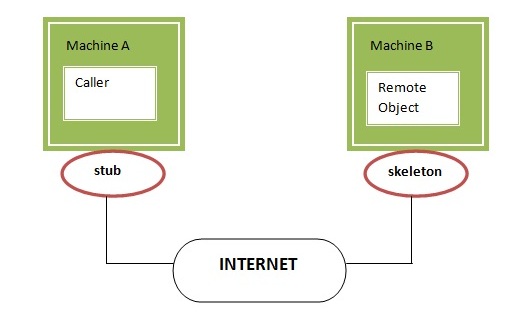
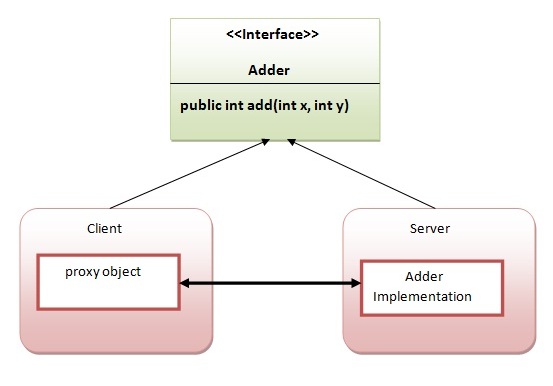
with an example which isn't too ambitious.In this example, we have followed all the 6 steps to create and run the
rmi application. The client application need only two files, remote
interface and client application. In the rmi application, both client
and server interacts with the remote interface. The client application
invokes methods on the
JAVA Remote Method Invocation (RMI)
Remote method invocation allows applications to call
object methods located remotely, sharing resources and processing load across systems.
Unlike other systems for remote execution which require that only simple data types or
defined structures be passed to and from methods, RMI allows any Java object type to be
used - even if the client or server has never encountered it before. RMI allows both
client and server to dynamically load new object types as required.
Tuesday, September 29, 2015
Study About Enterprise Java Beans (EJB) Introduction
Enterprise Java Beans (EJB) is a development architecture for building
highly scalable and robust enterprise level applications to be deployed
on J2EE compliant Application Server such as JBOSS, Web Logic etc.
A recent study by Java developer Raghu Kodali has shown that porting Sun's Java EE tutorial application RosterApp from EJB 2.1 to EJB 3.0 resulted in
Sunday, September 27, 2015
WSO2 ESB Mediator
Mediators provide an easy way of extending the ESB functionalities.
WSO2 ESB is based on the WSO2 Carbon platform, which uses OSGI as the
underlying technology. It implies everything that runs inside the WSO2
ESB to be OSGI bundles.
Thursday, September 17, 2015
WSO2 ESB Feed Inbound Endpoint
Atom 1.0
Atom
is the name of an XML-based Web content and metadata syndication
format, and an application-level protocol for publishing and editing Web
resources belonging to periodically updated websites. All Atom feeds
must be well-formed XML documents, and are identified with the application/atom+xml media type.
Friday, August 28, 2015
WSO2 ESB Feed Connector
Atom
is the name of an XML-based Web content and metadata syndication
format, and an application-level protocol for publishing and editing Web
resources belonging to periodically updated websites. All Atom feeds
must be well-formed XML documents, and are identified with the application/atom+xml media type.
Wednesday, August 26, 2015
Getting Started with Simple Apache Abdera Server
Apache Abdera provides an implementation of the IETF Atom Syndication
Format and Atom Publishing Protocol standards (RFC's 4287 and 5023). In this blog we're going to walk through how to build an Atom
Publishing Protocol service server sample using Abdera's concepts of Providers and
Collection Adapters. If you remember your AtomPub basics, you'll recall
that AtomPub services are organized in a hierarchical way such that we
have:
Labels:
abdera,
apache,
experience,
feed,
Java,
Web Services
Saturday, August 22, 2015
Getting Started with Simple WSO2 ESB Custom Inbound Endpoint
WSO2 ESB supports several inbound endpoints, but there can be
scenarios that require functionality not provided by the existing
inbound endpoints. For example, you might need an inbound endpoint to
connect to a certain back-end server or vendor specific protocol.
Sunday, August 9, 2015
WSO2 ESB Inbound Endpoint
Inbound
Endpoint is an endpoint which resides in server side of the ESB. Those
are introduced to achieve some of the main features like multi tenancy
support for some protocols like JMS, by passing axis2 layer in Inbound
side,deploying and undeploying inbound endpoints without server
restarting.
Basically there are two behaviours introduced. Selection
of the behaviour is done according to protocol.
- Polling behaviour
- Listening behaviour
Sunday, July 26, 2015
Getting Started with Simple WSO2 ESB Connectors
A WSO2 connector allows you to interact with a third-party product's functionality and data from your ESB message flow, enabling you to connect to and interact with the APIs of services such as Twitter, Salesforce, and JIRA. This means that if you have enabled the Twitter and Google Spreadsheet connectors in your ESB instance,
Wednesday, July 8, 2015
Development challanges
Error-1
java.lang.ClassFormatError: Illegal local variable table start_pc 39 in method org.apache.synapse.transport.passthru.PassThroughHttpSender.sendUsingOutputStream(Lorg/apache/axis2/context/MessageContext;)Vjava.lang.ClassFormatError: Illegal local variable table length 81 in method org.apache.synapse.transport.passthru.PassThroughHttpSender.maintenanceShutdown(J)V
Solution
adding the JVM arg
-XX:-UseSplitVerifier(in wso2server.sh/bat)Ex:- $JAVACMD \
-Xbootclasspath/a:"$CARBON_XBOOTCLASSPATH" \
-Xms256m -Xmx1024m -XX:MaxPermSize=256m \
-XX:-UseSplitVerifier \###############################################
Error-1
When we run load test on ESB server by default it will only allow 20 concurrent threads to send out so if we increase the size of the thread in synapse properties(//repository/conf/synapse.properties) we may encounter the error.
[CodeBlob (0x00007f3fc1051e10)]
Framesize: 0
BufferBlob (0x00007f3fc1051e10) used for StubRoutines (2)
#
# A fatal error has been detected by the Java Runtime Environment:
#
# Internal Error (sharedRuntime.cpp:834), pid=4948, tid=139907131430656
# fatal error: exception happened outside interpreter, nmethods and vtable stubs at pc 0x00007f3fc105436f
#
# JRE version: Java(TM) SE Runtime Environment (8.0_45-b14) (build 1.8.0_45-b14)
# Java VM: Java HotSpot(TM) 64-Bit Server VM (25.45-b02 mixed mode linux-amd64 compressed oops)
# Failed to write core dump. Core dumps have been disabled. To enable core dumping, try "ulimit -c unlimited" before starting Java again
#
# An error report file with more information is saved as:
# /home/rajjaz/Documents/ESB/wso2esb-5.0.0-RC/hs_err_pid4948.log
#
# If you would like to submit a bug report, please visit:
# http://bugreport.java.com/bugreport/crash.jsp
#
Aborted (core dumped)
Solution
Increase the number based on the machine capacity
Tuesday, June 23, 2015
What is WSO2 Enterprise Service Bus (ESB)
An enterprise service bus (ESB) is a software architecture construct
that enables communication among various applications. Instead of having
to make each of your applications communicate directly with each other
in all their various formats, each application simply communicates with
the ESB, which handles transforming and routing the messages to their
appropriate destinations.
Subscribe to:
Posts (Atom)