Each authenticator provides you a way to authenticate the user using
specific external authentication system. For example if you want to
authenticate a user who logs into your application using Dropbox
authenticator, you need to configure the Dropbox authenticator for your
identity provider .The Dropbox authenticator allows you to authenticate user using Dropbox through WSO2 IS.
Tuesday, January 12, 2016
WSO2 Identity Server Dropbox Authenticator
Sunday, January 10, 2016
Creating WSO2 IS Custom Federated Authenticator
WSO2 IS custom authenticators provides you a way to authenticate the user using specific external authentication system. through the authenticators we can secure our systems. Before start development Research the APIs provided by the service for which you want to create an authenticator.
Tuesday, December 15, 2015
Run Integration Test with WSO2 ESB EJB2 Connector and Jboss 5.1
As we discussed earlier EJB2 connector is a tool to make calls between remote EJB2.X objects and wso2 ESB. there are two type of calls we can call.Stateless and stateful where stateless is a one time call and stateful maintain a state between remote object and client. Integration Test for EJB2.X connector written based on Jboss 5.1 server so there are some pre configuration we need to set before we run the integration test.
in this blog lets see how to configure ESB before run the test and what are the libraries we need to add to ESB and Test Client. Integration test is very important to check the stability of connector(to validate the methods).
Sunday, December 13, 2015
WSO2 ESB EJB 2.x Connector
Enterprise
JavaBeans is an architecture for transactional, component-based
distributed computing. The specification for EJBs lays out not just the
format of a bean itself, but also a set of services that must be
provided by the container in which the bean runs. This makes EJBs a
powerful development methodology for distributed application
development. Neither the bean developer nor the client application
programmer needs to be concerned with service details such as
transaction support, security, remote object access, and many other
complicated and error-prone issues. These are provided transparently for
the developers by the EJB server and container.
Saturday, November 14, 2015
Writing WSO2 ESB Connector Integration Test
We assume that readers have basic knowledge about TestNG and Connector. If not please get the knowledge about connector development from here before read this post. In this post we are analyzing how we can implement a connector integration test. Integration test is very important to evaluate the effectiveness of the connector functions. This post will focus on integration test based on Hello World Sample.
Thursday, October 15, 2015
Getting Started with Simple wso2 ESB EJB Mediator Sample
The EJB mediator calls an external Enterprise
JavaBean(EJB) and stores the result in the message payload or in a
message context property. Currently, this mediator supports EJB3
Stateless Session Beans and Stateful Session Beans.
Wednesday, October 7, 2015
WSO2 ESB EJB Mediator
The EJB mediator calls an external Enterprise
JavaBean(EJB) and stores the result in the message payload or in a
message context property. Currently, this mediator supports EJB3
Stateless Session Beans and Stateful Session Beans.
Getting Started with Simple Remote EJB 3.X Server Sample
This sample will give you a simple working experience with EJB client server . here I’m using netbeans as IDE and JBoss 5.1 as my EJB Container. and I created seperate client for Stateful an Stateless EJB sessions in order to make easy the development .We'll create a ejb module project named EJBTestServer.Wednesday, September 30, 2015
Getting Started with Simple RMI services
Writing your own RMI services can be a little difficult at first, so we'll start off
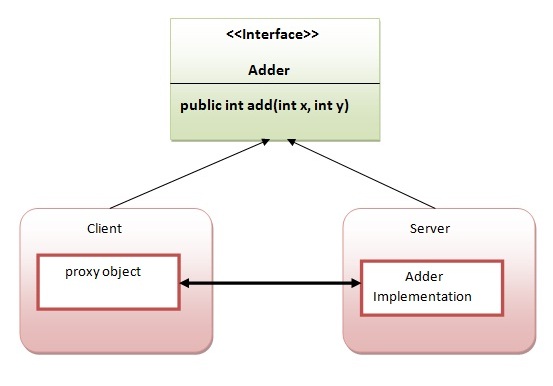
with an example which isn't too ambitious.In this example, we have followed all the 6 steps to create and run the
rmi application. The client application need only two files, remote
interface and client application. In the rmi application, both client
and server interacts with the remote interface. The client application
invokes methods on the
JAVA Remote Method Invocation (RMI)
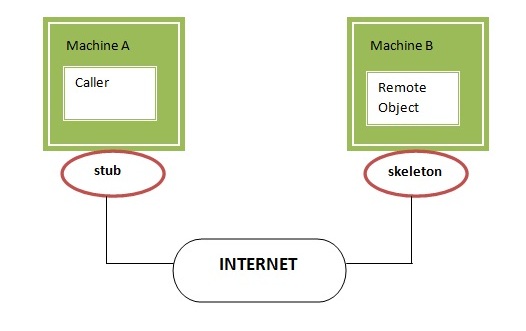
Remote method invocation allows applications to call
object methods located remotely, sharing resources and processing load across systems.
Unlike other systems for remote execution which require that only simple data types or
defined structures be passed to and from methods, RMI allows any Java object type to be
used - even if the client or server has never encountered it before. RMI allows both
client and server to dynamically load new object types as required.
Tuesday, September 29, 2015
Study About Enterprise Java Beans (EJB) Introduction
Enterprise Java Beans (EJB) is a development architecture for building
highly scalable and robust enterprise level applications to be deployed
on J2EE compliant Application Server such as JBOSS, Web Logic etc.
A recent study by Java developer Raghu Kodali has shown that porting Sun's Java EE tutorial application RosterApp from EJB 2.1 to EJB 3.0 resulted in
Sunday, September 27, 2015
WSO2 ESB Mediator
Mediators provide an easy way of extending the ESB functionalities.
WSO2 ESB is based on the WSO2 Carbon platform, which uses OSGI as the
underlying technology. It implies everything that runs inside the WSO2
ESB to be OSGI bundles.
Thursday, September 17, 2015
WSO2 ESB Feed Inbound Endpoint
Atom 1.0
Atom
is the name of an XML-based Web content and metadata syndication
format, and an application-level protocol for publishing and editing Web
resources belonging to periodically updated websites. All Atom feeds
must be well-formed XML documents, and are identified with the application/atom+xml media type.
Friday, August 28, 2015
WSO2 ESB Feed Connector
Atom
is the name of an XML-based Web content and metadata syndication
format, and an application-level protocol for publishing and editing Web
resources belonging to periodically updated websites. All Atom feeds
must be well-formed XML documents, and are identified with the application/atom+xml media type.
Wednesday, August 26, 2015
Getting Started with Simple Apache Abdera Server
Apache Abdera provides an implementation of the IETF Atom Syndication
Format and Atom Publishing Protocol standards (RFC's 4287 and 5023). In this blog we're going to walk through how to build an Atom
Publishing Protocol service server sample using Abdera's concepts of Providers and
Collection Adapters. If you remember your AtomPub basics, you'll recall
that AtomPub services are organized in a hierarchical way such that we
have:
Labels:
abdera,
apache,
experience,
feed,
Java,
Web Services
Subscribe to:
Posts (Atom)